- Date: July 14, 2026
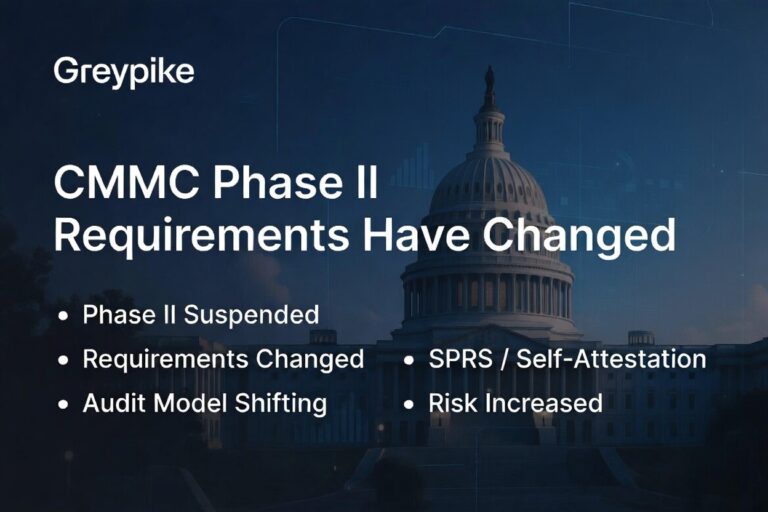
CMMC Phase 2 Suspended: What You Still Have to Do in 2026
- 20 min read
- 0 comment
CMMC Phase 2 C3PAO assessments are suspended. Your NIST 800-171 and SPRS obligations are not. Read the plain-English breakdown →
You’re in a defense supply chain, which makes you a target — and it’s why the requirements exist in the first place. Greypike runs both halves: the monitoring, testing, and response that keep you from getting hit, and the controls and evidence that keep you eligible to bid. Technology and AI do the work that scales; credentialed practitioners own the judgment that doesn’t.
We don’t hand you tools. We run the function.
Smaller suppliers get attacked precisely because they’re the least defended route into a prime’s data — which is exactly why DFARS 7012, CMMC, export control, and every prime security questionnaire exist. You’re now carrying both the risk and the paperwork, usually with no CISO, no security team, and no one whose actual job this is.
Attackers work up the supply chain, not down it. Your size doesn’t make you uninteresting — it makes you the least defended path to data someone actually wants.
CMMC for the DoD. SSPA for Microsoft. SOC 2 for the commercial side. It’s largely the same evidence rebuilt from scratch, over and over, on your time.
Software gives you a dashboard and a list of gaps. Someone still has to implement the controls, write the policy, run the reviews, and answer for the result.
The engagement ends, the binder goes stale, and your posture quietly decays — right up until an audit, an affirmation, or an incident puts it back in the open.
What you need isn’t a tool or a project. It’s a function that runs continuously — defending you and documenting it, with a named team accountable for both. That’s what we are.
Most firms make you pick one. A platform sells you automation with nobody accountable. A consultancy sells you hours that don’t scale and end when the invoice does. We built Greypike to be both, in one team.
Our Compliance App does the parts that are mechanical, high-volume, and easy to get wrong when a human does them by hand at 11pm.
Scoping calls, risk acceptance, and how a control actually gets implemented in your environment are judgment calls. Those stay with people.
Implement once. Attest many. We build one canonical set of controls in your environment, then project it across every framework your customers ask for — instead of starting over each time.
A compliance shop leaves you documented and breached. A monitoring vendor leaves you defended and disqualified. These are halves of one job, and they break when they’re bought from different vendors — so we run all three practices, and nothing falls between them.
Detection, response, and testing — run by us, so you’re not staffing a security operation you can’t afford.
One control set, mapped across every framework your customers require — implemented, evidenced, and kept current.
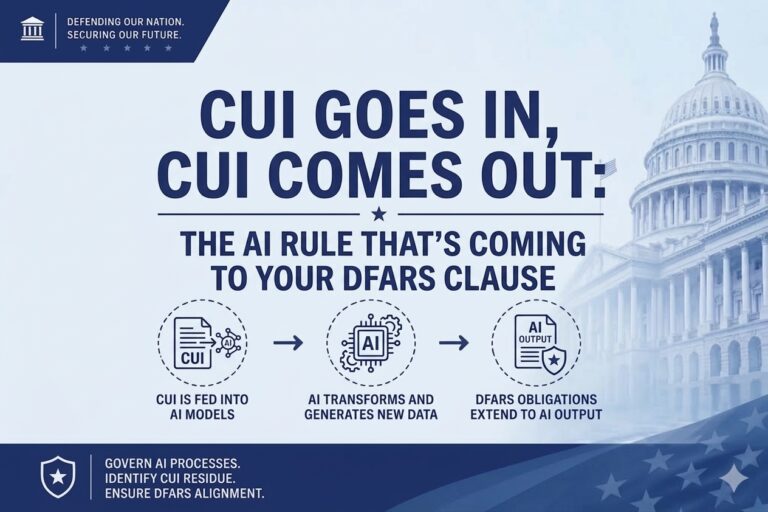
Adopt AI without creating a new class of risk — or a new set of findings at your next assessment.
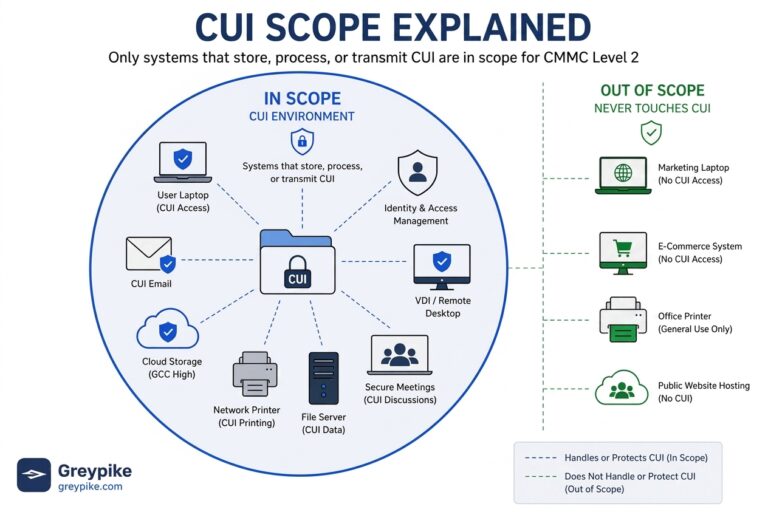
Most of what makes compliance expensive is scope — sensitive data scattered across email, laptops, and shared drives drags your whole company into the boundary. The Secure Enclave puts it in one hardened environment we build and operate for you, so the rest of your business falls out of scope.
Built for CUI, ITAR/EAR, and other controlled data under NIST SP 800-171 — the environment your CMMC and DFARS obligations live in.
Microsoft GCC High · Google Assured Workloads
Same containment model for customer data, IP, and regulated commercial workloads — where SOC 2, HIPAA, or a prime’s security requirements are the driver.
Microsoft 365 Commercial · Google Workspace
Sensitive data lives in one boundary instead of everywhere.
Requirements are engineered into the environment, not bolted on later.
The account is yours. We operate it for you — no black box, no lock-in.
Copilot, Gemini, and agents run in-scope, not on outside systems.
A full-time CISO is a quarter-million-dollar decision most contractors your size can’t justify — but the questions a CISO answers still land on someone’s desk every week. Our vCISO takes them.
Delivered as a tiered monthly retainer, with the managed security stack included per seat. You get a named practitioner who knows your environment — not a rotating queue.
Explore vCISOYour customers keep asking for different certifications against largely the same underlying controls. We build the control set once in your environment, then map it to whichever framework is in front of you.
We implement and prepare — we don’t grade. Greypike is not a C3PAO, a CPA firm, or a QSA. That separation is deliberate: it keeps the work we do for you defensible when someone else comes to check it.
We’re a veteran-owned firm working exclusively with government contractors. We know what your primes ask for, what your contracting officer expects, and what actually holds up under scrutiny.
You shouldn’t have to choose between a cheap tool that leaves the work to you and a consultant who bills by the hour. Our software absorbs the volume so our practitioners can afford to be thorough.
Greypike is not a C3PAO or an auditor, and that separation is by design. We make your posture defensible, then step aside when someone independent comes to verify it.
When we enable AI, it runs inside your own accredited environment — never on Greypike systems, never on your controlled data from the outside. We build and govern it; your environment runs it.
The people on your account are credentialed practitioners and hands-on security engineers — not account managers relaying questions to someone else. We don’t backdate evidence, we don’t fabricate artifacts, and we’ll tell you when the honest answer is that you’re not ready yet.
Real outcomes for real clients — from higher SPRS scores to protected contract value.
in SPRS score
Defense Security Consulting Firm
Maryland, USA
in DoD contracts
Intelligence & Defense Contractor
Maryland, USA
using the Greypike Compliance App
Lighthouse Research Group
Virginia, USA
One conversation. We map what you handle, what an attacker would go after, what your customers require, and what it would actually take to run properly. You’ll leave with a straight answer either way.