A Practitioner’s Guide From a Veteran-Owned Cyber AB Registered Provider Organization — Real Numbers, Real Case Studies, and the Five Strategies That Save Defense Contractors Six Figures
Published: May 13, 2026 | Last Updated: May 13, 2026 | Reading time: 13 minutes
Authored by: Greypike CMMC Practitioner Team Reviewed by: Greypike Compliance Leadership
Greypike Inc. is a Veteran-Owned Small Business (VOSB) specializing in CMMC compliance for the Defense Industrial Base. This guide reflects working strategies refined across dozens of CMMC engagements with defense contractors of every size and structure.
Why You Can Trust This Guide
This article was developed by Greypike’s CMMC practitioner team — the same people who walk defense contractors through scope decisions every working day. Our credentials and authority signals:
- Veteran-Owned | Founded and operated by U.S. military veterans
- SBA Certified VOSB | Verified Veteran-Owned Small Business
- CAGE Code: 9WVS6 | Active in the federal contractor ecosystem
- Headquartered in Virginia | Serving the entire Defense Industrial Base nationwide
- Specialization: CMMC Level 2 readiness for small and mid-sized defense contractors
Every recommendation in this guide comes from direct, hands-on engagement with contractor environments — not theoretical analysis. We’ve personally scoped CMMC assessments for aerospace primes, sheet-metal fabricators, IT service providers, software developers, and engineering firms across the DIB.
Key Takeaways
- CMMC scope reduction is the single highest-leverage way to cut three-year compliance costs — typically 30–60% savings versus a default whole-environment scope.
- The Department of Defense’s own framework under 32 CFR § 170.19 was designed to let contractors exclude assets that don’t process CUI or protect CUI assets — most contractors don’t use it.
- A 40-person contractor can realistically save $192,800 over three years by moving from whole-environment compliance to a properly bounded CUI enclave architecture.
- C3PAO assessment fees scale directly with environment size: $35K–$50K for a clean enclave vs. $100K–$150K for a sprawling whole-environment scope.
- Five legitimate strategies drive most of the cost savings: enclave architecture, CRMA designation, Specialized Asset categorization, rigorous separation, and ESP vetting.
- First-time C3PAO assessment failure rates run 15–35% — boundary misalignment is the leading cause, making CMMC scope reduction a risk-mitigation move, not just a cost play.
Table of Contents
- What CMMC Scope Reduction Actually Means
- Why Scope Is the Highest-Leverage Cost Decision
- The Five CMMC Asset Categories: Comparison Table
- Where Over-Scoping Quietly Inflates Your Bill
- A Real Case Study: $545K vs. $352K
- The Five Highest-Impact Scope Reduction Strategies
- The Five Most Common Mistakes That Wreck Scoping
- Frequently Asked Questions
- How Greypike Helps GovCons Execute Scope Reduction
What CMMC Scope Reduction Actually Means
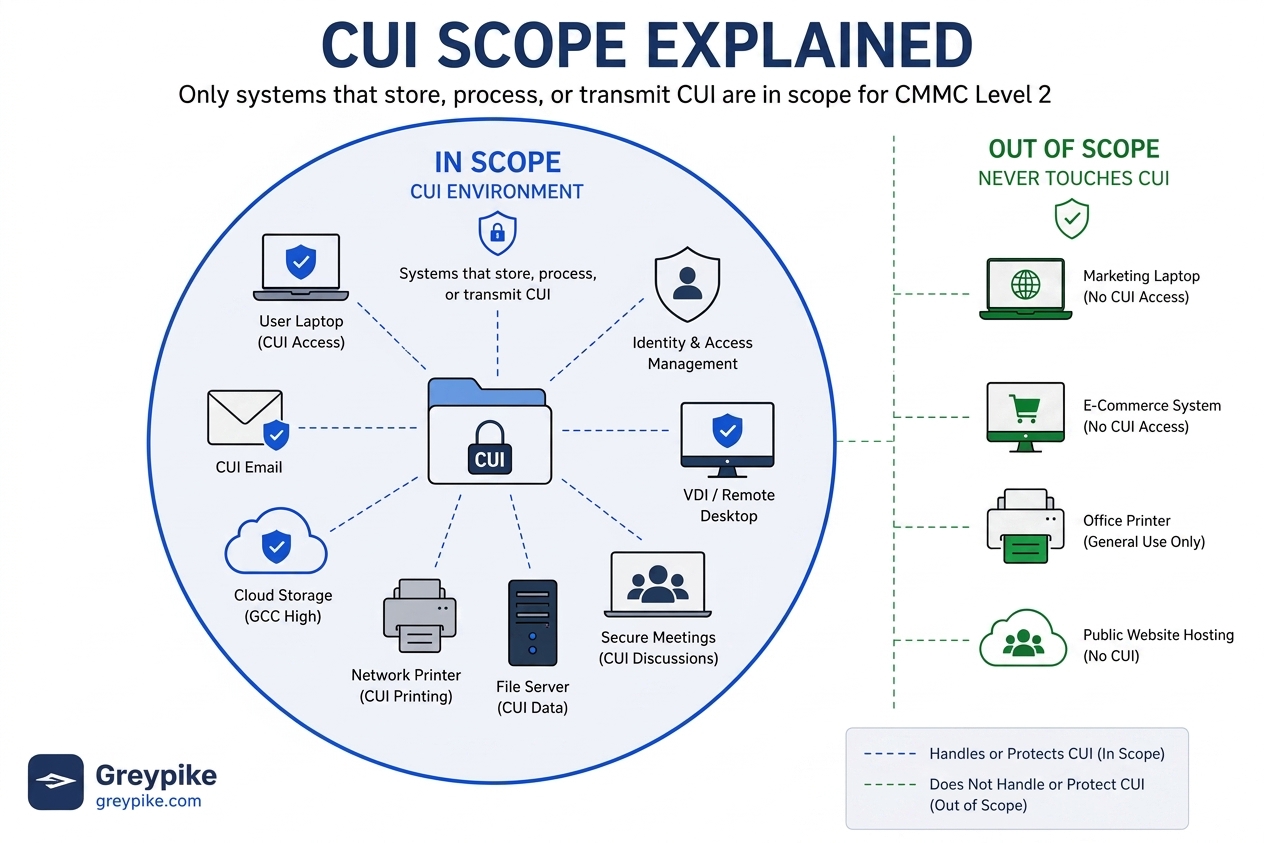
CMMC scope reduction is the disciplined practice of shrinking the number of systems, users, and external services that fall inside your CMMC Level 2 assessment boundary. Under 32 CFR § 170.19, the Department of Defense formally recognizes five asset categories — and the entire point of that framework is to let defense contractors legitimately exclude assets that don’t process, store, or transmit Controlled Unclassified Information (CUI), and that don’t provide security protection for CUI assets.
In our scoping work with defense contractors, the pattern we see most often is this: contractors sweep their entire environment into scope because they think that’s the safe play. It isn’t. Every asset you legitimately keep outside the boundary is an asset you don’t pay to protect, license, monitor, or have a C3PAO assess. Every asset you sweep in unnecessarily triggers the full weight of NIST SP 800-171’s 110 controls, three years of licensing fees, and additional C3PAO assessor time.
The contractors we work with who execute CMMC scope reduction well end up with assessment boundaries that are 40–70% smaller than their default would have been. The contractors who don’t pay for the privilege of over-protecting payroll workstations.
Why CMMC Scope Reduction Is the Highest-Leverage Cost Decision
Most defense contractors think they’ll save money on CMMC by negotiating with vendors, picking a cheaper C3PAO, or buying tools at the lower end of the market. The data — and our direct experience — says otherwise. Across the engagements our team has worked, the cost variable that explains the most variance in three-year totals isn’t vendor selection. It’s scope size.
The Department of Defense’s own published estimate in the 32 CFR Part 170 Final Rule places Level 2 certification at approximately $104,670 for small contractors. PreVeil’s 2026 survey of 2,000 defense contractors revealed that 70% had budgeted less than that figure — meaning the typical contractor is under-budget by $30,000–$50,000 before any scope mistakes are factored in. Over-scope on top of that, and you’re looking at $200,000+ in unplanned overruns.
We’ve seen this play out repeatedly in contractor engagements. The contractors who come to us before scoping decisions are made consistently land within their compliance budget. The contractors who arrive after deploying full-environment tooling are usually trying to reduce a problem we could have prevented for free.
Effective CMMC scope reduction isn’t about cutting corners on security. It’s about using the DoD’s own framework correctly so you only pay to protect what actually needs protection.
The Five CMMC Asset Categories: Quick-Reference Comparison Table
Every asset in your environment must be categorized into one of five buckets under 32 CFR § 170.19(c)(1), Table 3. Understanding these categories is the foundation of every other scope reduction decision. We use this exact framework as the first step in every contractor engagement.
| Asset Category | What It Is | In Scope? | Assessment Treatment | Cost Impact |
|---|---|---|---|---|
| CUI Assets | Systems that directly process, store, or transmit CUI | ✅ Yes | Assessed against all 110 NIST 800-171 controls | HIGH — drives most assessment cost |
| Security Protection Assets (SPAs) | Systems that protect CUI assets (SIEM, EDR, MFA, firewalls) | ✅ Yes | Assessed against controls relevant to capability | MEDIUM — required but limited scope |
| Contractor Risk Managed Assets (CRMAs) | Can access CUI but not designed to | ✅ Yes | SSP documentation review (not full 110 controls) | LOW — major scope reduction lever |
| Specialized Assets | OT, IoT, GFE, test equipment | ✅ Yes | SSP documentation review | LOW — saves substantial cost vs. CUI Asset designation |
| Out-of-Scope Assets | No CUI access, no security protection role | ❌ No | Not assessed (no documentation required) | ZERO — the goal of scope reduction |
The single highest-leverage move in CMMC scope reduction is moving as many assets as legitimately possible into the bottom three rows — CRMAs, Specialized Assets, and Out-of-Scope Assets — and out of the top two rows. The Department of Defense built these categories specifically to give contractors that flexibility. Contractors who don’t use them are leaving money on the table the DoD never intended them to spend.
Where Over-Scoping Quietly Inflates Your Bill
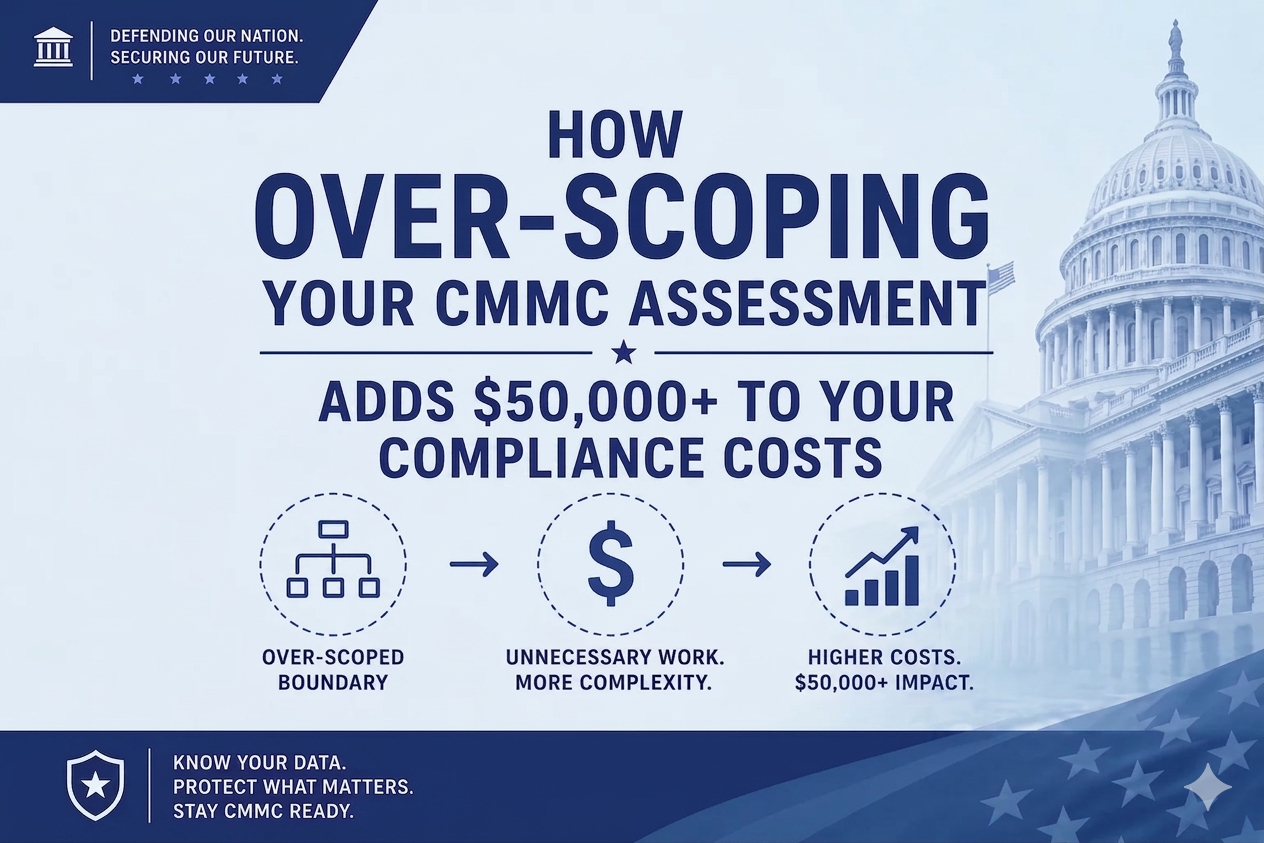
Five specific cost categories scale directly with the size of your CMMC Level 2 assessment boundary. In our cost modeling work, these are the five line items that consistently account for the biggest swing between an over-scoped and a properly-scoped budget. Effective scope reduction attacks all five simultaneously.
1. C3PAO Assessment Fees Scale with Environment Size
A small, well-scoped enclave-based assessment routinely runs $35,000 to $50,000 for the C3PAO assessment fee. A sprawling whole-company assessment runs $100,000 to $150,000 — sometimes more, depending on complexity and assessor-days required.
That’s a $50K–$100K direct cost differential, before you’ve added a single tool. The C3PAO is billing for time, and time scales with the number of assets, controls, and interview subjects in scope. Anyone who has been through a C3PAO assessment can confirm this — the bigger the boundary, the longer the assessment, the higher the bill.
2. Per-Endpoint Licensing Stacks Up Fast
Every endpoint inside your boundary needs the full security stack: EDR, MFA, encryption, vulnerability scanning, configuration management, log forwarding to SIEM. Conservative licensing runs $100 to $300 per endpoint per year depending on platform choices.
A 50-endpoint scope at $200/endpoint/year is $10,000 annually — $30,000 over three years. Move 30 of those endpoints out of scope through proper scoping, and that $18,000 stays in your bank account. We’ve watched this exact swing happen in dozens of engagements.
3. SIEM and Log Aggregation Pricing Punishes Volume
Most SIEM platforms price on data volume — gigabytes per day, events per second, or endpoint count. Over-scoping doesn’t just add more endpoints; it adds more log volume, which pushes you into higher pricing tiers.
A contractor running an enclave-scoped SIEM might pay $12,000–$25,000 annually. The same contractor running a whole-environment SIEM commonly pays $40,000–$80,000. That’s $60,000–$165,000 over three years for a single line item — a category most contractors don’t account for until the invoices start arriving.
4. Remediation Costs Scale Linearly with Scope
For every endpoint, server, and cloud service in scope, you’ll do remediation work to bring it into compliance with the controls assessed against it. Industry data places small-contractor remediation costs anywhere from $20,000 on the low end to $250,000 on the high end, and the variable explaining most of that spread — based on our experience modeling these projects — is scope size, not tool choice.
5. Failed Assessment Risk Scales with Scope Complexity
First-time C3PAO assessment failure rates run 15% to 35% depending on preparation quality. From our discussions with C3PAOs and our own assessment-prep work, the single biggest driver of failures is boundary misalignment — the assessor finding assets that should have been in scope but weren’t documented, or finding documentation that doesn’t match the environment.
A failed assessment adds $10,000 to $30,000 in re-assessment fees, $10,000 to $50,000 in additional remediation, and 90 to 180 days of lost contract eligibility. The contractors most likely to fail are the ones with the largest, most complex scopes — which is yet another reason CMMC scope reduction is a risk-mitigation strategy, not just a cost-savings play.
Want to See What Your Scope Could Actually Be?
Greypike built a free Scope Reduction Calculator that walks through your CUI workflows, user counts, and architecture, then models what a properly bounded scope would look like — and what each path would cost over three years. Same model our team runs with paying clients on day one of every engagement.
Use the Scope Reduction Calculator →
A Real Cost Comparison: $545K vs. $352K (Same Company, Two Boundaries)
Consider a 40-person defense contractor with 12 engineers handling CUI on technical drawings. This is a composite example drawn from multiple Greypike client engagements — the numbers reflect real-world cost structures we’ve documented across the DIB. Two architectural paths, two very different three-year totals.
Three-Year Cost Breakdown: Two Scoping Approaches
| Cost Line Item | Path A: Whole Environment (No Scope Reduction) | Path B: Enclave (Proper Scope Reduction) |
|---|---|---|
| C3PAO assessment fee | $100,000 | $45,000 |
| Endpoint licensing (3 yr) | $30,000 | $0 (covered by enclave subscription) |
| Enclave subscription (12 users × $350 × 36 mo) | N/A | $151,200 |
| SIEM and log aggregation (3 yr) | $135,000 | $36,000 |
| Remediation | $100,000 | $30,000 |
| Managed compliance (3 yr) | $180,000 | $90,000 |
| Three-Year Total | $545,000 | $352,200 |
Difference: $192,800 — and that gap exists not because Path B is doing less compliance work, but because Path B isn’t doing compliance work on systems that never needed it.
A similar published case from Ridge IT documented a 40-person manufacturer who reduced costs from $140K to $78K — a 45% reduction — by migrating CUI into an enclave. The industry-wide pattern is consistent: when contractors execute proper CMMC scope reduction, three-year cost reductions of 20–60% are routine.
This is the math behind every scoping conversation we have. It’s not about cutting corners. It’s about not paying for protection on assets the DoD framework was explicitly designed to let you exclude.
The Five Highest-Impact CMMC Scope Reduction Strategies
The strategies below are what actually move the needle in our engagements. None involve cutting compliance corners; all involve using the DoD’s own scoping framework the way it was designed.
1. Architect for a CUI Enclave
A CUI enclave — a hardened virtual desktop environment on GCC High, AWS GovCloud, or a compliant private cloud — is the single highest-leverage CMMC scope reduction decision available to small and mid-sized contractors. It produces the smallest defensible Level 2 assessment boundary because all CUI workflows live inside a tightly controlled environment, separated from the rest of your business systems.
For most small contractors with concentrated CUI workflows (engineers, project managers, technical writers), an enclave-based scope of 10–25 users is realistic and defensible. We see this architecture work consistently across aerospace, manufacturing, and software-development DIB segments.
2. Use the Contractor Risk Managed Asset (CRMA) Category
The Department of Defense explicitly created the CRMA category to let contractors include certain systems in the boundary without full 110-control assessment. CRMAs are reviewed by the C3PAO through the SSP, not through control-by-control testing.
In our experience, contractors who don’t use this category end up assessing assets at full Level 2 rigor that the framework was designed to handle differently — paying for assessment work the DoD never required. CRMA designation is one of the cheapest, most legitimate scoping moves available.
3. Designate Specialized Assets Correctly
Operational technology (OT), IoT, Government Furnished Equipment (GFE), and test equipment qualify as Specialized Assets. They’re assessed against your SSP documentation, not against all 110 controls.
Manufacturers in particular over-pay by treating shop-floor systems as CUI Assets when the Specialized Asset designation is the right answer. We see this mistake routinely in CAD/PLM environments, on CNC controllers, and on shop-floor terminals — and the savings on assessment time and remediation when contractors correct it are substantial.
4. Implement Physical and Logical Separation Rigorously
Out-of-Scope Assets only stay out-of-scope when the separation is documented and demonstrable. The two recognized methods under 32 CFR § 170.19:
- Physical separation — no wired or wireless connection between systems. Different networks, no shared infrastructure.
- Logical separation — connected systems with software-enforced isolation: VLANs, firewalls, VPNs, identity-based access controls, and dedicated enclaves with controlled egress.
Without separation, every scope reduction argument collapses. The framework defaults everything into scope when boundaries aren’t enforced. A C3PAO who can demonstrate a network path from an “out-of-scope” system to your CUI environment has every right to pull that asset back into scope on the spot.
5. Vet Every External Service Provider (ESP)
Each ESP touching CUI or Security Protection Data is in your scope. Vendors who handle CUI without FedRAMP Moderate authorization (or equivalent) force you into expensive workarounds or full-environment scopes.
The ESP traps we see most often in contractor environments: cloud backup vendors not FedRAMP authorized, RMM platforms used by MSPs that retain CUI access logs, help-desk platforms that store ticket attachments, and shared collaboration tools your team adopted without security review. Selecting the right ESPs upfront — and removing the wrong ones — is a routinely overlooked scoping lever.
The Five Most Common Mistakes That Wreck Your Scope Reduction
1. Treating Every Government-Related System as a CUI Asset
The most common over-scoping pattern we encounter. A finance workstation that occasionally opens a contract PDF gets flagged as a CUI Asset. A marketing laptop that emails a government POC gets flagged. The reality: most of these systems handle Federal Contract Information (FCI), not CUI, and belong in either a Level 1 scope or as properly documented CRMAs.
2. Building a “Phantom Enclave”
A CUI enclave that engineers regularly bypass — downloading CUI to local laptops, emailing it from corporate accounts — provides zero scope-reduction benefit. The enclave only works as a scope-reduction tool if the workflows actually stay inside it. Architecture without discipline is just expensive theater, and we’ve cleaned up more than a few of these in remediation engagements.
3. Forgetting Backup Systems
Your CUI lives on a hardened file server, but the backup runs to a general-purpose target on the corporate network. That backup target is now in your assessment boundary, regardless of intent. Backup systems are the most common scoping failure mode we see in contractor environments — and one of the easiest to fix when caught early.
4. Letting Scope Drift Over Time
Even a well-defined initial scope drifts. New cloud applications get adopted, new contract modifications change CUI flows, new subcontractors get added. Contractors who don’t run a scope review at every contract change inherit a slowly inflating boundary — and inflation costs money for three years until recertification.
5. Skipping a Mock Assessment
Before a C3PAO sees your scope, run a mock assessment against it. Walk the network, verify segmentation, test isolation, and confirm every asset is where the SSP says it is. Discrepancies found in mock are cheap. Discrepancies found by a C3PAO are expensive — and they almost always result in scope expansion mid-assessment, erasing the scoping work you did upfront.
Frequently Asked Questions About CMMC Scope Reduction
How much can CMMC scope reduction realistically save my company?
Based on our engagement data and published industry case studies, the typical contractor sees 30–60% three-year cost reductions when moving from an over-scoped whole-environment architecture to a properly bounded enclave architecture. For a small defense contractor, that’s typically $150,000 to $300,000 in savings over the certification cycle. Published case studies show 45% cost reductions are routine when CUI workflows are properly enclaved.
Will a C3PAO accept a tightly bounded CMMC assessment scope?
Yes — when it’s properly documented and the separation is real. C3PAOs assess what you propose in your System Security Plan. A clean, defensible enclave-based assessment boundary with documented separation and accurate SSP documentation is exactly what a reputable assessor wants to see, because it makes the assessment faster and more conclusive for everyone.
What is a CUI enclave and how does it support scope reduction?
A CUI enclave is a hardened, segmented environment — typically a virtual desktop on Microsoft GCC High, AWS GovCloud, or a compliant private cloud — where all CUI workflows are contained. By restricting CUI to the enclave and separating it from the rest of your business systems, you can scope your CMMC Level 2 assessment to the enclave only — dramatically reducing the number of assets that need to meet all 110 NIST 800-171 controls.
When should I start thinking about CMMC scope reduction?
Before you spend a dollar on remediation. Scope reduction is an architectural decision, and architectural decisions made at the start of a CMMC program compound for three years. Contractors who come to us only after they’ve already deployed full-environment tooling typically can’t recover the cost — they’re stuck paying for an over-scoped environment until recertification.
Can scope reduction work for defense manufacturers with shop-floor systems?
Yes, but it requires careful Specialized Asset categorization and rigorous network segmentation. Manufacturers handling CUI on technical drawings, CAD/PLM systems, and CNC machines should use the Specialized Asset designation for OT equipment, isolate CAD/PLM environments via VDI, and keep shop-floor systems on separate network segments. This approach can reduce scope substantially even in complex manufacturing environments — we’ve designed exactly these architectures for clients.
What’s the difference between physical and logical separation?
Physical separation means no wired or wireless connection between systems — different networks, different facilities, no shared infrastructure. Logical separation uses software-enforced controls (VLANs, firewalls, identity boundaries, network segmentation) to isolate systems that share physical infrastructure. Both are recognized methods under 32 CFR § 170.19, but logical separation requires meticulous documentation to hold up under C3PAO scrutiny.
Do External Service Providers (ESPs) count toward my CMMC assessment scope?
Yes. Any ESP that processes, stores, or transmits your CUI or Security Protection Data is in your CMMC Level 2 assessment boundary. Cloud Service Providers handling CUI must be FedRAMP Moderate authorized (or equivalent). Failing to identify and properly document ESPs is one of the leading causes of failed assessments. Vet every vendor with access to your CUI environment as part of your scoping work.
Is CMMC scope reduction ever the wrong strategy?
Rarely, but yes. Some manufacturers with deeply integrated IT/OT environments find the change-management cost of moving to an enclave is higher than the ongoing premium of full-environment certification. Some prime contractor relationships require enterprise-level compliance demonstrations that exceed an enclave’s footprint. For most small and mid-sized contractors, though, scope reduction is the right answer — and the math heavily favors it.
Helpful Articles & Information
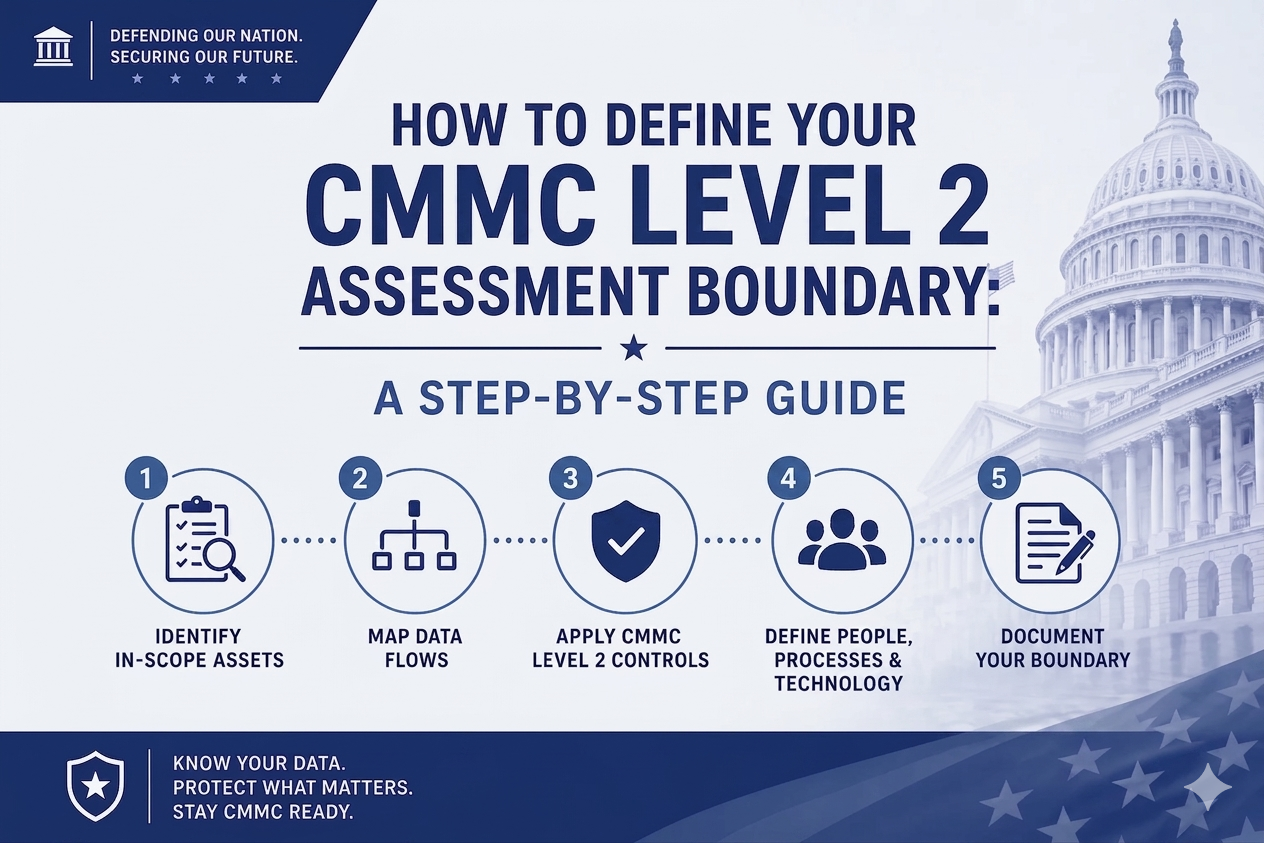
- How to Define Your CMMC Level 2 Assessment Boundary: A Step-by-Step Guide
- What Is a CMMC Assessment Boundary?
- CMMC Level 2 Small Business Cost: The Three Realistic Paths
- CUI vs FCI: Which of Your Systems Need to Be CMMC-Certified?
- C3PAO vs RPO: Which One Do You Actually Need?
- CMMC Scoping: The #1 Key to Compliance Success
- Greypike CMMC Compliance Services
Authoritative External References
- 32 CFR § 170.19 — CMMC Scoping (eCFR)
- 32 CFR Part 170 — CMMC Program Final Rule (Federal Register)
- NIST SP 800-171 Rev. 2 — Protecting Controlled Unclassified Information
- National Archives CUI Registry
- Cyber AB Marketplace — Find Authorized C3PAOs and RPOs
How Greypike Helps GovCons Execute CMMC Scope Reduction
Greypike is a Veteran-Owned small business working with small and mid-sized Defense Industrial Base contractors on CMMC readiness every day. The most consistent observation across our engagements: the contractors who save the most money are the ones who get scope reduction right before they spend a dollar on remediation. Architecture decisions made at the start of a CMMC program compound for three years.
Our team helps contractors map every CUI data flow, categorize every asset under the five-category framework, design enclave architectures that keep the assessment surface as small as the contracts require, and produce SSP documentation that survives C3PAO scrutiny. Our Greypike Enclave service deploys a hardened, CUI-compliant VDI environment on Google or Microsoft government clouds, giving small contractors a defensible technical boundary on day one with predictable per-user costs that make three-year budgets real.
If you suspect your current scope is too wide — or if you haven’t drawn one yet and want to start with the smallest defensible footprint — there’s a free tool worth running before you commit to anything.
Use the Scope Reduction Calculator →
The calculator walks you through your CUI workflows, your user counts, and your existing architecture, then models what a properly bounded scope would look like and what each path would cost over three years. It’s the same workflow our team runs with paying clients on day one of every engagement — before anyone spends a dollar on tooling.
Visit greypike.com or call (703) 214-9246 to talk through your CMMC scope reduction strategy.
About Greypike Inc.
Greypike Inc. is a Veteran-Owned cybersecurity and CMMC compliance firm based in Virginia, serving the Defense Industrial Base nationwide.
Credentials & Authority Signals:
- Veteran-Owned Small Business (VOSB) — SBA Certified
- CAGE Code: 9WVS6
- Specialization: CMMC Level 2 readiness for small and mid-sized defense contractors
- Service area: All 50 states; in-person engagements available in the Mid-Atlantic and DC Metro region
What we do: Greypike specializes in CMMC scope reduction, CUI enclave architecture, SSP documentation, gap assessments, and ongoing compliance management for DIB contractors. Our team has guided contractors across aerospace, manufacturing, IT services, software development, and engineering services through the CMMC certification process.
Contact: Visit greypike.com or call (703) 214-9246 to speak with a CMMC practitioner.
Greypike Inc. — Veteran-Owned. Mission-Focused. Compliance-Ready.