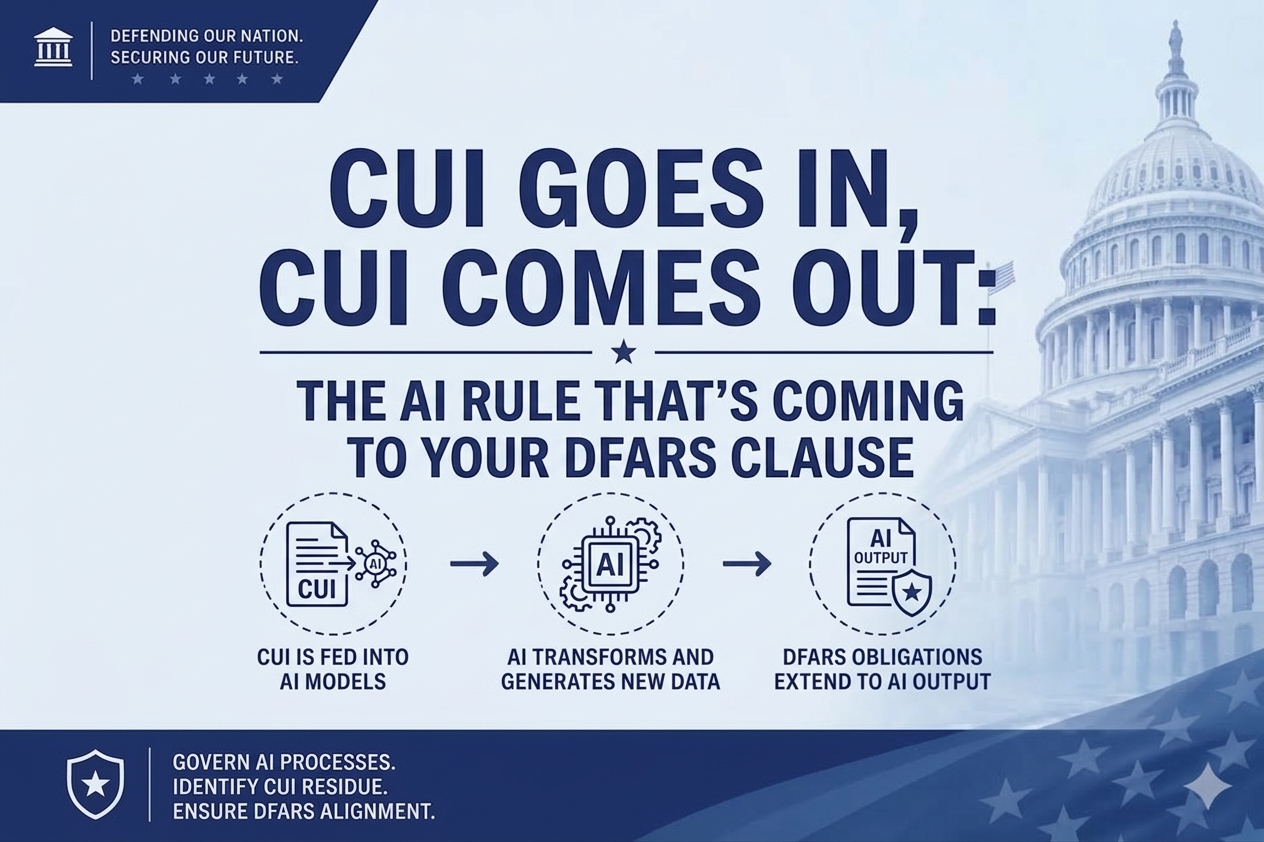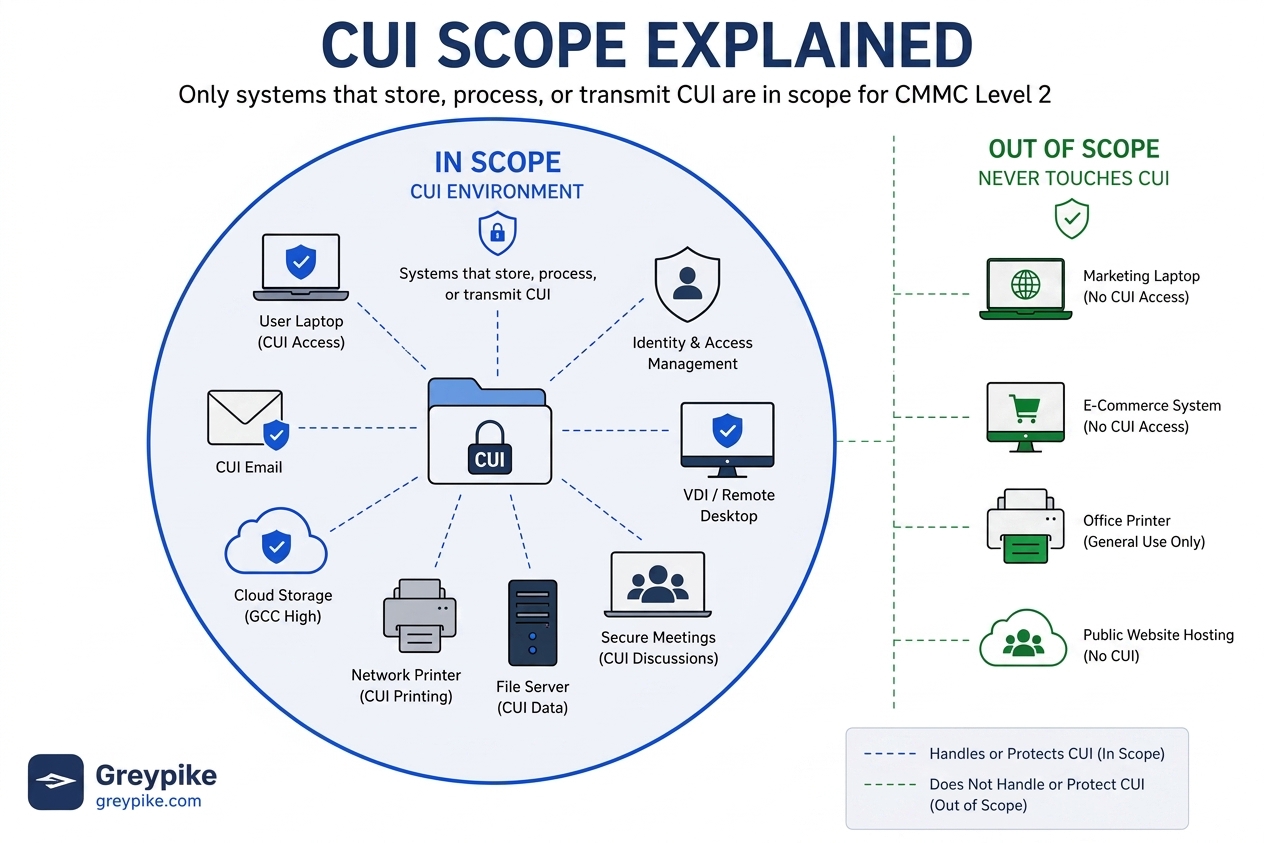
ITAR AI compliance is the conversation happening right now in government contracting circles — and it has potentially far more serious legal consequences than a CMMC finding. An ITAR violation isn’t a certification issue. The ITAR AI risk doesn’t require a foreign actor or a traditional breach. It’s a federal crime.
It’s the intersection of AI tools and ITAR. And compared to a CMMC finding, an ITAR violation isn’t a certification issue. It’s a federal crime.
What ITAR AI Compliance Actually Requires
The International Traffic in Arms Regulations govern the export and transfer of defense articles, defense services, and related technical data. If your company touches anything on the United States Munitions List — weapons systems, military electronics, spacecraft components, propulsion systems, targeting technology, and a wide range of dual-use items — you are operating under ITAR, whether or not you think of yourself as an “ITAR company.”
The critical word in ITAR, the one that most people don’t fully reckon with, is export. ITAR defines export broadly. It isn’t just about physically shipping hardware overseas. It includes:
- Transmitting technical data to a foreign national anywhere, including on U.S. soil
- Providing access to ITAR-controlled information via electronic systems
- Disclosing technical data to an unauthorized party — foreign or domestic — in ways that weren’t approved under the terms of your license or exemption
That last one is where AI enters the picture.
The Moment You Paste Technical Data into a Commercial AI
Here’s the scenario. An engineer at a defense subcontractor is working on a deliverable. It involves technical specifications — materials, tolerances, performance parameters — for a component that falls under an ECCN classification on the USML. She needs to clean up a report. She opens ChatGPT, pastes in the technical content, and asks it to improve the formatting and clarity.
What just happened?
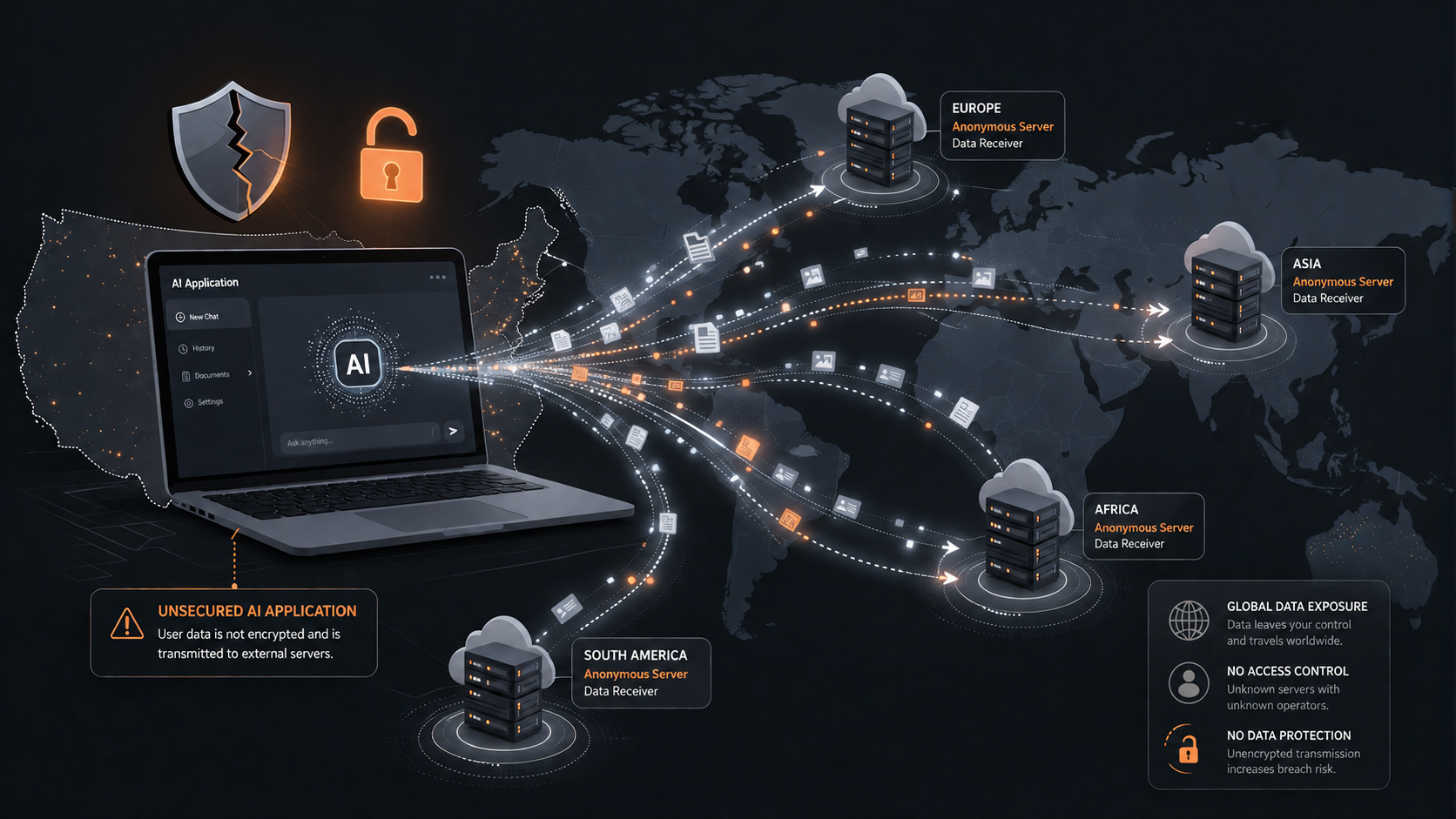
She transmitted technical data to an external system operated by a private company. That company’s infrastructure may be distributed across multiple countries. The engineers who maintain and improve that system may include foreign nationals. The model training pipeline may expose inputs in ways that haven’t been publicly documented. None of this was authorized under her company’s ITAR license or export exemption.
That’s not a CMMC problem. That’s a potential ITAR violation. And ITAR violations can carry criminal penalties, civil fines up to $1 million per violation, and debarment from government contracting.
The answer isn’t to ban AI outright — that battle was lost before it started, and the productivity cost is real. The answer is to make sure the AI your team is using never touches a system outside your compliant environment. When AI is deployed inside your accredited boundary — with full audit logging, role-based access controls, and a data handling posture that can withstand a DDTC inquiry — your team gets everything they’re looking for without the legal exposure. The problem isn’t AI. It’s where the data goes when AI processes it.
Why This Is Different from a CUI Spill
CUI data handled improperly is a serious compliance failure with significant consequences — contract termination, failed assessments, and reputational damage. But ITAR exposure exists in a different legal category entirely. It is governed by the Arms Export Control Act. DDTC — the Directorate of Defense Trade Controls at State — is the enforcement authority, and they operate independently of DoD’s CMMC program.
A company can be fully CMMC Level 2 certified and still have significant ITAR exposure if its employees are using commercial AI tools to process export-controlled technical data. These are parallel compliance regimes, and satisfying one does not satisfy the other.
The ITAR risk doesn’t require a foreign government actor. It doesn’t require a breach in the traditional sense. It just requires that ITAR-controlled technical data be transmitted to a system that wasn’t authorized to receive it.
The “It Was Just a Summary” Defense Doesn’t Work
One of the patterns we see is a well-intentioned misunderstanding about what triggers ITAR. Some engineers and program managers operate under the belief that if they’re not sharing the actual design files — just asking AI to help with a summary, or a literature review, or a written description — they’re in the clear.
They’re not.
ITAR controls technical data, which is defined to include information required for the design, development, production, manufacture, assembly, operation, repair, testing, maintenance, or modification of defense articles. Verbal descriptions of technical specifications. Performance parameters. Material compositions. Tolerances. Failure modes. These are all technical data under ITAR, regardless of what format they appear in.
If the information you’re feeding into an AI tool would require an export license to share with a foreign national, it requires the same care when transmitted to any unauthorized system — including a commercial AI platform.
The Specific AI Behaviors That Create ITAR Exposure
These are the scenarios with the highest risk profile:
Pasting technical specs or design parameters into a commercial chatbot. Even a partial description of a controlled component’s operating characteristics can constitute ITAR-controlled technical data. “Help me write this up more clearly,” doesn’t change what the underlying data is.
Using AI to generate or refine proposals with technical content. Proposal writers regularly pull from prior deliverables and performance data to structure new bids. If that content includes ITAR-controlled technical descriptions, the AI tool just became an unauthorized recipient. This is one of the most common workflows in any defense contractor’s day — and one of the most overlooked exposure points. It’s also exactly the kind of task that compliant AI, deployed inside your accredited boundary, can handle without incident. Drafting technical volumes, refining capability statements, summarizing prior performance — all of it can happen safely when the environment is right.
Uploading documents with embedded technical data to AI file analysis tools. Many commercial AI platforms now accept PDF and document uploads. A test report, a system specification, a technical data package — these often contain controlled information even when the person uploading them doesn’t consciously identify them as ITAR documents.
Using AI-assisted meeting note tools that capture technical discussions. Some organizations are deploying AI transcription and summarization tools for internal meetings. If those meetings involve ITAR-controlled technical content, the transcription tool is now processing data it isn’t authorized to hold.
Allowing foreign national employees to interact with AI tools that have been fed controlled data. This is a disclosure issue that most small contractors haven’t fully thought through — particularly when AI tools are configured with organizational context that includes sensitive technical material. Role-based access controls — the kind that specify who can use AI, what data they can process, and what capabilities are available to them — exist precisely to close this gap.
The Visibility Problem Is Worse for ITAR
With CUI and CMMC, there’s at least a defined scope: the data is classified at the information level, handled according to documented procedures, and tracked in system security plans. Assessors can look for gaps.
ITAR exposure is harder to map because most companies don’t have a complete inventory of what data in their environment is ITAR-controlled. The classification question — is this technical data subject to ITAR? — requires legal and technical judgment. Not everything in a defense contractor’s environment is controlled. But a significant portion of it may be, and most employees making day-to-day decisions about what to put into an AI tool don’t have the training to make that determination in real time.
That gap — between what employees think is fine to use and what actually carries ITAR exposure — is where the risk lives. And it’s why the audit trail matters as much as the technical controls. When an assessor or examiner asks you to demonstrate that controlled data was protected, “we think our people were careful” is not a sufficient answer. Logged, auditable evidence of what was processed, by whom, and where is what actually closes the finding.
What a Compliant Posture Actually Requires
For defense contractors operating under ITAR, using AI in a compliant way requires more than just picking a FedRAMP-authorized tool — though that’s a necessary starting point. It requires:
A technology control plan that explicitly addresses AI. If your TCP doesn’t have a section on AI tools, you have a gap. The TCP governs how ITAR-controlled technical data is accessed, stored, and transmitted — and AI tools are now a real transmission vector.
A clear definition of what data in your environment is ITAR-controlled. You can’t train employees to protect data they can’t identify. Someone in your organization needs to have done the classification work and communicated it clearly.
Employee training that connects ITAR obligations to AI behavior specifically. General ITAR training won’t cover this. People need to understand that “sending data to an AI” is legally equivalent to “transmitting data to a third party” — and that the same rules apply.
Contractual commitments from any AI vendor about data handling, residency, and access. FedRAMP authorization is a floor, not a ceiling. You need to understand whether the vendor has foreign national employees with access to infrastructure that processes your data, and what their commitments are about model training and data retention. The right answer is an environment where your data never leaves your accredited boundary — not a promise buried in a terms of service.
An AI use policy that integrates with, not just references, your ITAR compliance program. These two frameworks need to be coordinated. The same AI tool decision that satisfies CMMC requirements may still fail ITAR standards.
The Regulatory Trajectory
ITAR isn’t a new regulation — it’s been in place for decades. But AI creates a genuinely new surface area that ITAR’s traditional enforcement framework wasn’t built to contemplate. DDTC has not yet issued formal guidance specifically addressing AI and ITAR, which some companies interpret as a green light. It isn’t.
The absence of specific AI guidance from DDTC means the existing regulations apply as written — and those regulations are broad enough to cover the scenarios described here. When specific AI guidance does arrive, it is unlikely to be more permissive than current rules. The regulatory trend in this space runs in one direction.
The contractors who get ahead of this now are the ones who will have something to show an examiner when the formal guidance lands.
Frequently Asked Questions
Does ITAR apply if my company is only a subcontractor? Yes. ITAR obligations flow down through the supply chain. If your company manufactures, modifies, or provides technical support for items on the USML — or if you receive ITAR-controlled technical data from a prime — your ITAR obligations are the same as the prime’s, scoped to your specific work.
What if the AI company says it doesn’t train on enterprise data? That’s an important data point, but it’s not sufficient on its own. You need a written contractual commitment, not a marketing claim. You also need to understand the infrastructure: where data is processed, who has access to it, and whether foreign nationals are involved in system development and maintenance, which is a distinct ITAR concern from model training.
Is this only a concern for the largest defense primes? No. In fact, small and mid-sized contractors are more exposed precisely because they lack the legal and compliance infrastructure to identify and manage this risk. Large primes have ITAR compliance teams. A 20-person defense subcontractor almost certainly does not — and that’s exactly the environment where casual AI use is most likely to go unexamined.
Does CMMC compliance protect me from ITAR enforcement? No. These are separate regulatory regimes with separate enforcement authorities. CMMC compliance addresses your cybersecurity posture under DoD contracting requirements. ITAR violations are enforced by the State Department under the Arms Export Control Act. A clean CMMC assessment provides no shelter from ITAR exposure.
Your Team Is Already Using AI. The Question Is Whether It’s Crossing Your Compliance Boundary.
If your team is using ChatGPT, Microsoft Copilot, or any commercial AI platform to draft proposals, summarize contracts, or process technical data, that information is leaving your compliance boundary. Under CMMC, that’s an assessor finding. Under ITAR, the consequences can go further. If your ITAR AI posture hasn’t been reviewed since your team started using these tools, that’s the gap to close.
The answer isn’t to ban AI. It’s to use AI that was built for this environment.
GreypikeAI gives your team the productivity they’re already reaching for — proposal writing, contract review, compliance drafting, report generation, policy development — deployed inside your FedRAMP High enclave. Your data never leaves your compliant boundary. Every session is logged and auditable. Evidence is ready for your C3PAO assessors before they ask for it.
Here’s what that means practically:
| Without GreypikeAI (Violations) | With GreypikeAI |
|---|---|
| CUI flows into ChatGPT, Copilot, or other commercial AI | AI deployed inside your compliant enclave boundary |
| Data processed outside your FedRAMP boundary | CUI never leaves your FedRAMP High environment |
| No audit trail — no way to prove CUI was protected | Every session is logged and auditable |
| CMMC assessment finding — potential contract risk | Evidence-ready for C3PAO assessors |
What your team will actually use GreypikeAI for:
- Proposal writing — Draft and refine DoD contract proposals, capability statements, and technical volumes, with CUI handled safely
- Contract review — Summarize requirements, flag CUI handling obligations, and identify compliance gaps in new solicitations
- Policy development — Draft and update CMMC-required policies mapped to your controls
- Workflow automation — Generate evidence reports, draft status updates, and route approvals without moving CUI outside your boundary
- Report generation — Turn raw compliance data into executive-ready summaries in minutes
- Training content — Build security awareness materials and role-specific guidance for your team
Every deployment includes full audit logging, role-based access controls, custom agents built to your specific workflows, and monthly usage reports confirming no data crossed your compliance boundary.
See GreypikeAI in action.
Book a 15-30 minute demo, and we’ll show you exactly how it works inside a compliant enclave — and what it can do for your team’s day-to-day workflows.
[Book a Demo →] [See Pricing →]
Questions? We’re easy to reach. 📞 (703) 214-9246 ✉️ info@greypike.com
Greypike Inc. — Veteran-Owned. Mission-Focused. Compliance-Ready. CAGE: 9WVS6 | SAM UEI: N6CJNGDARFM5 | SBA Certified VOSB